and the knowledge to use it for your greater good. Phil Chave
|
|
|
Distant Healer - Give yourself the gift of healing energy, the wisdom to accept it, and the knowledge to use it for your greater good. Phil Chave |
|
Home About Phil Request Healing Contact Treatments Articles Products Appointments Gift Solutions  Phil Chave creator of Distant Healer |
Scoliosis Help and Treatment: Using Spinal Touch for ScoliosisScoliosis of the spine? Find improvement through Spinal Touch and Bio Stress ReleaseAre you worried about scoliosis in your spine? Is it getting worse over time? Been told that invasive surgery is your only option? Keep reading! Scoliosis is Greek for 'crooked', and is characterised by a lateral curvature of the spine. The term 'lateral' suggests there is movement only in two planes, but in fact, scoliosis can be a complex 3 dimensional problem.
Scoliosis cannot be caused by a bad posture, exercise, diet or through the use of backpacks or satchels. In the case of the most common form of scoliosis (around 80%), adolescent idiopathic scoliosis, there is no clear causal agent (Idiopathic means arising spontaneously or from an obscure or unknown cause). There are four main subgroups within this class: primary skeletal, neuromuscular, metabolic and hereditary. Scoliosis affects three to four children out of every 1,000 in the UK. In 90% of cases of scoliosis, treatment is not required because the condition corrects itself as the child grows into adulthood. There are two broad divisions of scoliosis; one being structural and the other non-structural. Scoliosis is more often diagnosed in females (with a ratio of around 5:1) and is often seen in patients with cerebral palsy or spina bifida, although this form of scoliosis is different from that seen in children without these conditions. In some cases, scoliosis exists at birth due to a congenital vertebral anomaly. Congenital, is the second type of scoliosis and develops in the fetus, either through the failure of the vertebrae to form symmetrically or through failure of the vertebrae to separate completely during formation and growth in utero. Congenital scoliosis is structural so that, in addition to a lateral curvature, there is vertebral rotation. Non-structural scoliosis has no underlying structural abnormality and is much easier to rectify, either with therapy, exercises or specifically non-invasive treatments. How do the different types of scoliosis compare? When a structural scoliosis is present, there are abnormalities of the vertebrae and ribs. The vertebral bodies are rotated toward the convexity of the curve, while the spinous processes deviate towards the concavity of the curvature, adding a transverse plane rotational element to the lateral flexion. Consequently, patients will present with symptoms that can include the following:
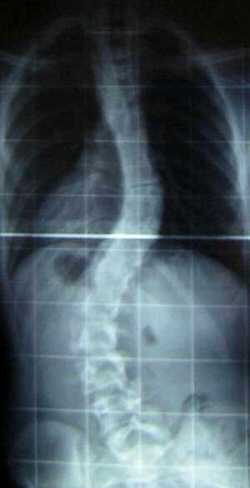
While a small degree of lateral curvature does not cause any medical problems, larger curves can cause postural imbalance and lead to muscle fatigue and pain. More severe scoliosis can interfere with breathing and lead to arthritis of the spine (spondylosis). The progression of any scoliotic condition is believed to be largely controlled by mechanical factors. The 'Hueter-Volkmann Law' states that compression forces inhibit growth and tensile forces stimulate growth. Also, Julius Wolff (1836–1902) a German surgeon, proposed in 'Wolff's law' that mechanical stress was responsible for determining the architecture of bone. Remodeling of bone occurs in response to physical stresses - or to the lack of them - in that bone is deposited in sites subjected to stress and is resorbed from sites where there is little stress. What do these laws tell us? The Hueter-Volkmann law proposes that the increased compression on the concave side of a curvature decreases the rate of growth in those vertebrae, while a corresponding reduction in compression on the convex side, accelerates growth. It is possible that, once an unnatural force has started the process of long term spinal flexion, compression of the bony structures, the vertebral bodies and the apophyseal joints which comprise the superior and inferior facets, is progressed by gravity acting on the weight of the upper body. With the uncorrected concave compression comes a reduction in growth rate, while the 'free' side, the convex side, is able to grow at a normal pace, and may even become accelerated as there will be an area of unused space between the bony structures. We know nature abhors a vacuum. The bony elements on the convex side grow bigger and the ligamentous structures between the vertebrae must stretch and/or lengthen permanently. The curve, which by now has become a normal feature of the spine is liable to progress further if there is still significant growth potential in an individual, due to age. What about leg length inequality being a contributing factor? Common sense tells me that this is very likely, but sometimes this is not born out by research. I do wonder if differences in leg length cause wear and tear in the spinal discs of the lumbar region because of the larger swings of the pelvis during walking and running. The sacro-iliac joint, even if it can absorb some of the displacement, will pass much more on up the spine, and this may cause degenerative changes to the intervertebral discs and the apophyseal joints. Compressions increase as a compensatory lumbar curve develops and a corresponding thoracic curve further up the spine. How is the degree of scoliosis measured?  Firstly, one or more x-rays will usually be taken to define the curve or curves more precisely. X-rays can show spinal maturity, spinal deformity or abnormality, pelvic tilt or hip asymmetry, and the location, extent, and degree of curvature. The curve is defined in terms of its beginning and ending points, its direction, and by an angle measure known as the 'Cobb angle'. The Cobb angle is found by projecting lines parallel to the vertebrae tops at the extremes of the curve, projecting perpendiculars from these lines, and measuring the angle of intersection (see the picture on the left).
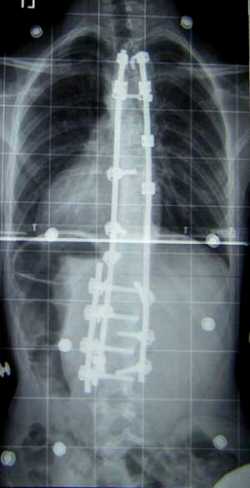
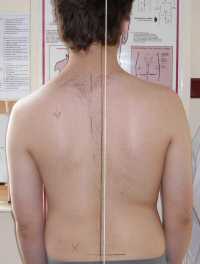
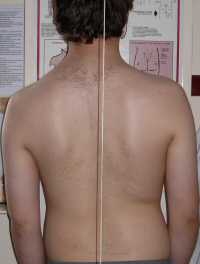
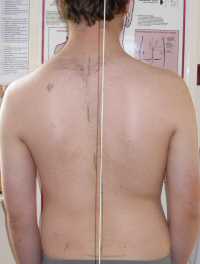
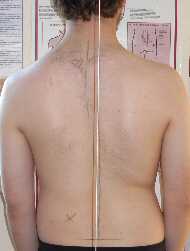
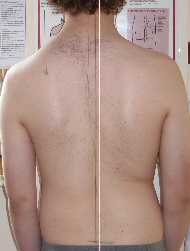
What is the prognosis for scoliosis? The prognosis of scoliosis depends on the likelihood of progression. The general rules of progression are that larger curves carry a higher risk of progression than smaller curves, and that thoracic and double primary curves carry a higher risk of progression than single lumbar or thoracolumbar curves. In addition, patients who have not yet reached skeletal maturity have a higher likelihood of progression. What treatments are available for scoliosis? The traditional medical management of scoliosis is complex and is determined by the severity of the curvature, skeletal maturity, which together help predict the likelihood of progression. The conventional options are, in order: 1. Observation 2. Bracing 3. Surgery Observation involves monitoring and basically adopting the wait and see approach. Bracing is normally done when the patient has bone growth remaining, and is generally implemented in order to hold the curve and prevent it from progressing to the point where surgery is indicated. Braces are sometimes also prescribed for adults to relieve pain. Bracing involves fitting the patient with a device that covers the torso, and in some cases it extends to the neck. A brace is usually worn 22-23 hours a day and applies pressure on the curves in the spine. The effectiveness of the brace depends not only on brace design, but on patient compliance and amount of wear per day. Bracing may cause emotional and physical discomfort. Physical activity may become more difficult because the brace presses against the stomach, making it difficult to breathe. Children may lose weight from the brace, due to increased pressure on the abdominal area. A soft, flexible brace came on the market in the 1990s and seems to perform well, but it is fair to say that bracing is controversial so far as its long-term outcomes are concerned. Surgery is usually indicated for curves that have a high likelihood of progression, curves that cause a significant amount of pain with some regularity, curves that would be cosmetically unacceptable as an adult, curves in patients with spina bifida and cerebral palsy that interfere with sitting and care, and curves that affect physiological functions such as breathing. Surgery for scoliosis is usually done by a surgeon who specializes in spine surgery. For various reasons it is usually impossible to completely straighten a scoliotic spine, but in most cases very good corrections are achieved. Spinal fusion is the most widely performed surgery for scoliosis. So what treatment are you talking about? I'm talking about Spinal Touch Therapy. I've found this simple procedure to be very effective in many cases of scoliosis, hence this article. See Photo's below ⇓ ⇓. My final message to you is this: If you are worried that your scoliosis is getting worse, or if your diagnosis suggests that it will become progressive, then the sooner you do something about it, the better. In addition, patients who have not yet reached skeletal maturity have a higher likelihood of progression, and so if you are the parent of such a child, then early treatment is recommended. Don't wait! The sooner we start analyzing your posture and making corrections, the sooner you are likely to see improvement in your condition. If you live in any of the towns and villages on the left of this article, you are well within a 2-40 minute drive of The Haven Healing Centre, and I'd be delighted to see you. Please call Phil Chave on 01934 740275 to make your appointment or to talk about a treatment plan structured around your needs. Don't wait. Make your appointment today. You'll be glad you did! 
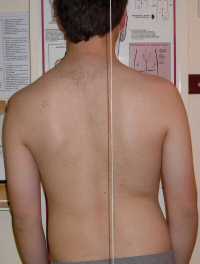
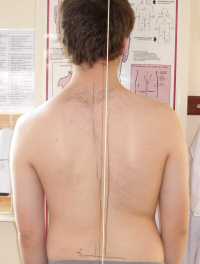
Some additional notes about the above pictures Can I bring your attention to the left picture in the third row? The curvature is emanating from higher and higher up the spine. The middle picture in the bottom row shows how the back is 'softening' in appearance and the neck appears more central as the curvature is 'unwinding'. I have inserted a straight red line on the last picture to demonstrate how the reversal of rotational curvature has brought the whole left side of the body back and around to a near correct posture. Now compare this last picture to the first one! Phil's note: Before you submit yourself, or members of your family, to invasive, painful, surgery, do you not owe it to yourself to explore all of the other options and opportunities available to you first? You've got nothing to lose … and everything to gain! Wierd spellings: Skoliosis, skoleosis, skolyosis, skoliocis, scoleosis, scolyosis, scoliocis, scoliosys. |
|
All of These Local Areas Are Within a Short Drive of The Haven Healing Centre, Cheddar, Somerset Abbots Leigh, Ashwick, Avonmouth, Axbridge, Babington, Backwell, Badgworth, Bagley, Banwell, Barrow Gurney, Bason Bridge, Bath, Beckington, Berrow, Biddisham, Bishop Sutton, Bitton, Blackford, Blagdon, Bleadon, Bleadney, Bradford-on-Avon, Brean, Brent Knoll, Bristol, Burnham-on-Sea, Burrington, Butcombe, Cameley, Catcott, Chantry, Chapel Allerton, Cheddar, Chelwood, Chew Magna, Chew Stoke, Chilcompton, Churchill, Clapton, Claverham, Claverton, Cleeve, Clevedon, Clutton, Cocklake, Coleford, Compton Bishop, Compton Dando, Compton Martin, Congresbury, Coxley, Cranmore, Cross, Downhead, Draycott, Dundry, Dunkerton, East Brent, East Harptree, East Huntspill, Easton-in-Gordano, Edithmead, Emborough, Englishcombe, Evercreech, Failand, Farmborough, Farrington Gurney, Felton, Flax Bourton, Freshford, Frome, Glastonbury, Godney, Green Ore, Gurney Slade, Highbridge, Highbury, High Littleton, Hinton Blewett, Hutton, Inglesbatch, Kelston, Kenn, Kewstoke, Keynsham, Kilmersdon, Kingston Seymour, Langford, Litton, Locking, Long Ashton, Lower Weare, Loxton, Lympsham, Mark, Marksbury, Mells, Midsomer Norton, Monkton Combe, Nailsea, Nempnett Thrubwell, Nettlebridge, Newbury, Oldmixon, Paulton, Peasedown, Pensford, Pilton, Portishead, Prestleigh, Priddy, Priston, Pucklechurch, Pudlow, Puxton, Queen Charlton, Radstock, Redhill, Rickford, Ridgehill, Rodney Stoke, Rooks Bridge, Rowberrow, Saltford, Sandford, Shapwick, Shepton Mallet, Shipham, Sidcot, Somerton, Stanton Drew, Star, Staverton, St Georges, Stoke St Michael, Ston Easton, Stone Bridge, Stowey, Street, Temple Cloud, Tickenham, Timsbury, Trowbridge, Ubley, Weare, Wedmore, Wellow, Wells, West Harptree, West Horrington, Weston-Super-Mare, West Pennard, Whatley, Whitchurch, Winford, Winscombe, Wookey, Wraxall, Wrington, Yatton For all enquiries please call Phil on: 01934 740275 |
|
Main Menu •
Home Page •
About Phil •
Request Healing •
Contact •
Treatments •
Articles •
|
|
DISCLAIMER: This information is not presented by a medical practitioner and is for educational and informational purposes only. The content is not intended to be a substitute for professional medical advice, diagnosis, or treatment. Always seek the advice of your physician or qualified health provider with any questions you may have regarding a medical condition. Never disregard professional medical advice or delay in seeking it because of something you have read. The Haven Healing Centre is located at: The Orchard, Draycott Rd, Cheddar, Somerset, BS27 3RU Xrays above: The copyright holder has released this work into the public domain. This applies worldwide. Wikimedia Commons |