All These Areas Are Within Easy Reach of The Haven Healing Centre, Blagdon, Bristol
To book your Spinal Touch/SPD Treatment at a convenient time, call: 01761 462722
Abbots Leigh
Ashwick
Avonmouth
Axbridge
Babington
Backwell
Badgworth
Bagley
Banwell
Barrow Gurney
Bason Bridge
Bath
Beckington
Berrow
Biddisham
Bishop Sutton
Bitton
Blackford
Blagdon
Bleadon
Bleadney
Bradford-on-Avon
Brean
Brent Knoll
Bristol
Burnham-on-Sea
Burrington
Butcombe
Cameley
Catcott
Chantry
Chapel Allerton
Cheddar
Chelwood
Chew Magna
Chew Stoke
Chilcompton
Churchill
Clapton
Claverham
Claverton
Cleeve
Clevedon
Clutton
Cocklake
Coleford
Compton Bishop
Compton Dando
Compton Martin
Congresbury
Coxley
Cranmore
Cross
Downhead
Draycott
Dundry
Dunkerton
East Brent
East Harptree
East Huntspill
Easton-in-Gordano
Edithmead
Emborough
Englishcombe
Evercreech
Failand
Farmborough
Farrington Gurney
Felton
Flax Bourton
Freshford
Frome
Glastonbury
Godney
Green Ore
Gurney Slade
Highbridge
Highbury
High Littleton
Hinton Blewett
Hutton
Inglesbatch
Kelston
Kenn
Kewstoke
Keynsham
Kilmersdon
Kingston Seymour
Langford
Litton
Locking
Long Ashton
Lower Weare
Loxton
Lympsham
Mark
Marksbury
Mells
Midsomer Norton
Monkton Combe
Nailsea
Nempnett Thrubwell
Nettlebridge
Newbury
Oldmixon
Paulton
Peasedown
Pensford
Pilton
Portishead
Prestleigh
Priddy
Priston
Pucklechurch
Pudlow
Puxton
Queen Charlton
Radstock
Redhill
Rickford
Ridgehill
Rodney Stoke
Rooks Bridge
Rowberrow
Saltford
Sandford
Shapwick
Shepton Mallet
Shipham
Sidcot
Somerton
Stanton Drew
Star
Staverton
St Georges
Stoke St Michael
Ston Easton
Stone Bridge
Stowey
Street
Temple Cloud
Tickenham
Timsbury
Trowbridge
Ubley
Weare
Wedmore
Wellow
Wells
West Harptree
West Horrington
Weston-Super-Mare
West Pennard
Whatley
Whitchurch
Winford
Winscombe
Wookey
Wraxall
Wrington
Yatton
For All Enquiries Please Call Phil On: 01761 462722
Do you know anyone with this condition? Why not tell them about this page? They'll be glad you did!
|
SPD - Symphysis Pubis Dysfunction and PGP - Pelvic Girdle Pain
SPD and PGP are pain and mobility problems commonly linked with pregnancy & childbirth
Do you suffer with SPD - Symphysis Pubis Dysfunction?
I am writing this article because more and more pregnant women are showing up in my practice who are suffering with pelvic pain that is not being dealt adequately through the normal channels. I think the reason may be partly because it is supposed to be a temporary problem when you are pregnant, which finds its own solution after childbirth.
These ladies are looking for alternative therapies for their SPD and PGP because what is on offer is the usual plethora of pain killing drugs handed out willy-nilly by an overstretched medical profession that doesn't seem to take it seriously. I know that's overstating the case, but not to the women who are in pain and seem unable to find relief or anyone who has anything useful to say besides, it will get better eventually.
While there is some debate as to what causes SPD, I am finding there is a viable solution in Spinal Touch Therapy and Bio Stress Release (some call this OrthoBionomy, Positional Release, Strain Counter Strain, which all seem to follow a similar pattern). By combining these therapies I have been able to show that a great deal of relief can be gained from pelvic pain and Symphysis Pubis Dysfunction, by correcting the distortions that seem to play a large part in their progression.

If you're not sure what Spinal Touch is, please visit my article, which explains how it works. Normally Spinal Touch is performed in the prone position (lying face down), but of course, when you're pregnant, this is impossible. I have therefore adapted the techniques and processes so that they can be performed with you on your side and yet still retain all the benefits of the routine when performed in the normal fashion.
Don't let the pain of SPD or PGP become a problem for you. The longer it goes untreated, the harder it is to treat.
If you live within around a 50 mile radius of Blagdon (near Bristol), North Somerset, I invite you to explore the benefits of this therapy and to arrange an appointment. You may like to ask your midwife prior to seeking help, as there may be a few who have heard of Spinal Touch. But it is likely that most will not. It is my hope that before long, as word spreads, midwives will send you as first point of reference, rather than recommend a prescription.
Note:- The only thing I would say is that this work is still in its infancy, and I came across these benefits as a side benefit to the Spinal Touch treatments which were done because of back issues during pregnancy. At that point, the ladies who came, did not link their SPD with their back pain. It was only after that we began to realize the two were linked. I don't have hundreds of pregnant ladies all shouting about how good this is, because this work is based on only a few examples, and, even less than the 40 you would need to suggest this was a realistic trial.
What I can say is, that, of the ladies that came, ALL of them benefited from the treatments, and ALL of them improved to the point where the SPD and PGP pain was no more. Of those who were still pregnant at the time, they reported that childbirth was easier and less painful than they had imagined it would be, and they attributed this directly to the posture correcting treatments they had received. One lady still had sharp and strong SPD six months after childbirth, still being told repeatedly, it would go away on its own and was a temporary problem. All this took was one treatment and the problem went away. Coincidence? Maybe. Placebo? Possibly. Gone now? You betcha!
On that basis, if you are willing to try, and, if you live close enough, I am willing to treat you. Contact me now to arrange an appointment.
What is SPD - Symphysis Pubis Dysfunction?
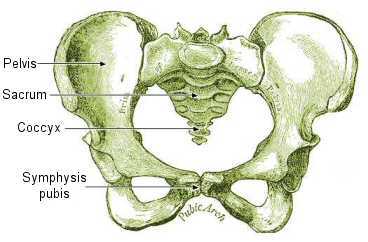
Symphysis Pubis Dysfunction(SPD) is pain in the pelvic joint at the pubis which can radiate around the front of the lower tummy down to the groin and top of the legs. SPD is most commonly associated with pregnancy and childbirth and is a condition that causes excessive movement of the symphysis pubis.
The symphysis pubis is the joint where two of the three pelvic bones meet at the front of the pelvis (The other two joints are the sacro-iliac joints at the rear of the pelvis). These pelvic joints are held together by very strong ligaments that are designed to prevent movement. The fibrocartilage holding the symphysis pubis together lengthens during pregnancy to prepare for the forces of childbirth. If the joint does not function sufficiently this can result in pain and or instability; this is Symphysis Pubis Dysfunction. SPD affects approximately 1 in 35 women.
What happens during pregnancy?
SPD is often attributed to hormonal fluctuation such as altering levels of hormones like relaxin and estrogen. Relaxin can increase tenfold in the body during pregnancy. Connective tissue in the sacro-iliac joint and pubic symphysis are believed to be influenced by oestrogen to produce relaxin receptors in varying concentrations. The influence of these hormones help remodel collagen that assists in the changes in soft tissue, cartilage and ligaments. This gradually loosens all the pelvic ligaments to allow slight movement at the time of birth. Occasionally, the ligaments loosen too much and too early before birth, and this loosening can cause the two pubic bones to move slightly out of alignment, thereby causing pain to occur.
It's likely this not the whole story, as there is growing evidence that built in asymmetry in the pelvis (perhaps even prior to pregnancy) may be to blame, responding by producing pain, due to shifting of the body's centre of gravity and uneven weight distribution during pregnancy. This would then be classed as a mechanical dysfunction, not a hormonal one.
For example, during weight bearing on one leg, one of the times when the pain can be at its worst, there is forward displacement of the pubic bone at the symphysis on the weight bearing side. This can cause translation (upward movement on one side, downward on the other) and separation.
However, not all pregnant women with pelvic pain have severe joint laxity, some will have pain due to pressure from the gravid uterus, a urinary tract infection, pain referred from higher in the spine, or nerve root irritation. Most of these can be attributed to postural distortion of the skeleton.
What are the symptoms of SPD and PGP?
- Symphysis Pubis pain, extremely tender to the touch.
- Present swelling and/or inflammation over joint.
- Difficulty lifting leg.
- Pain pulling legs apart.
- Unable to stand on one leg.
- Unable to transfer weight through pelvis and legs.
- Pain in hips and/or restriction of hip movement.
- Transferred nerve pain down leg.
- A feeling of symphysis pubis giving way.
- Stand with a stooped over back.
- Struggle to sit or stand.
- Pain may also radiate down the inner thighs.
- You may waddle or shuffle.
- Aware of an audible ‘clicking’ sound coming form the pelvis.
These symptoms can begin as early as the first trimester of the pregnancy with symptoms increasing towards the third trimester.
Perhaps the important thing to remember is that once your baby is born, your hormone levels start to return to normal, ligaments and the pelvic girdle return to normal, and for most women, the symptoms of SPD and PGP will gradually disappear.
One final thought: One thing did occur to me and that was, it's possible, due to hormonal influence and pelvic asymmetry, that the body is now working against itself, in that it is setting up conflict between ligament and cartilage, and muscles. The ligaments and cartilage are made to soften because of the presence of relaxin, whereas the muscles are trying to hold everything together, perhaps due to the memory they have of pre-pregnancy.
An imbalance here may cause the discomfort and pain because there is a tug-o-war going on that you have no control over. Indeed, many women describe there pelvis' as feeling like they are 'coming apart'. Now we're talking about a bio-mechanical dysfunction or asymmetry, and that is perhaps the reason why Spinal Touch is proving successful in this area. Could it be that relaxing the muscles (as Spinal Touch is designed to do), rewires the meaning of their existence, giving permission for them to work with the pelvis and ligaments in a new way, to bring re-alignment of pelvic posture and to allow the body to adjust proportionately to its new state, that of pregnancy?
If you would like to give Spinal Touch a try, contact me now to arrange an appointment.
But Phil, I live miles from The Haven Centre - There's no way I can get to you on a regular basis. Is there anything you can do to help me? Don't worry if you live a long way away, I have arranged a solution. Please visit
what to do if you live miles from The Haven Centre to find a possible solution that fits in with your plans for recovery. Hardly a week goes by without the phone ringing by someone deperate for hope from the pain and misery of SPD and PGP. The options for treatment in your area are probably the same as in ours - lacking. Don't worry if you live so far away it's impossible for you to come here regularly. My plan is for you to fly or drive here only once and take away the means to continue with your own recovery. Find out about this by clicking
here. Let's make the SPD treatment plan work for you!
To learn more about this treatment please visit: www.pelvicgirdlepain.co.uk.
Please share this page with your friends. Thank you.
If you have any thoughts on this, please write to me at:
Philip Chave © 2007-
Note: Please be aware that Healing, distant or otherwise, does not take the place of conventional medicine. Always consult a GP for an acute or infectious condition, and problems of an urgent nature. Continue with your prescribed medication. Healing is a complementary therapy that works effectively alongside orthodox/conventional healthcare, thus expanding your treatment options.
Want to help maintain the Distant Healing Service? Please visit: Online Donations. Thank You.
Go Back One Page Home Page Top
|